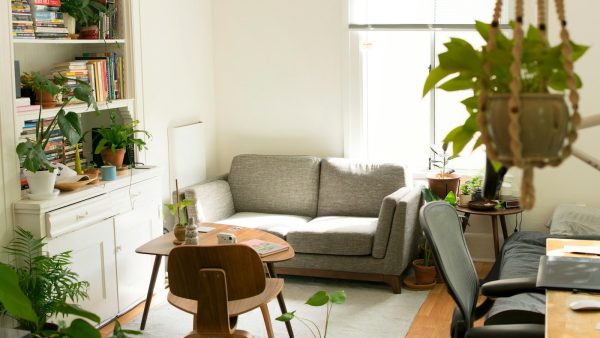


For months, my “office” was one end of the kitchen table, wedged between the fruit bowl and a pile of unopened posts. I’d sit down to work and within ten minutes I’d be up again, loading the dishwasher or staring at a stack of washing I hadn’t asked to notice. I wasn’t lazy. I was surrounded by every unfinished task in the house, all fighting for my attention at once.
Why Working Where You Live Wears You Down
There’s a reason it felt impossible to concentrate. When your workspace and your home life share the same room, your brain never gets a clear signal to switch modes. Every glance around the kitchen reminded me of something else I should be doing, and that mental noise chipped away at my focus before I’d typed a single sentence.
Natural light plays a part too. A UK study cited by Knight Frank found that office workers seated near windows concentrated for longer, with a 56% drop in drowsiness compared to those without a view. My kitchen table had a window, but it also had everything else. The light wasn’t the problem. The clutter was, and no amount of organising the room like a pro was going to fix a space that was never meant to be an office in the first place.
Moving My Desk Outside Reset My Brain
The shift that actually worked wasn’t a new planner or an earlier alarm. It was physically leaving the house. Once I set up a small desk in the garden, I had something I’d never had inside: a door I could close between “home” and “work.” Walking out to it in the morning became its own signal, and walking back in at the end of the day meant I actually left work behind instead of carrying it through every room.
Before the Build: A Garden Workspace Checklist
Before you get carried away picturing fairy lights and a laptop stand, it’s worth checking whether your space can handle it. Three things are worth ten minutes outside with a cup of tea:
Check the Ground Is Level
A slight slope can cause problems once you’re adding a base, so walk the space and look for dips or soft patches.
Measure the Distance From the House
This tells you whether your Wi-Fi will reach comfortably, and how far power cables need to run.
Assess Your Privacy From Neighbours
Note where you’re overlooked, so screening or planting can go on the list before the desk does.
Setting the Space Up for Actual Focus, Not Just Aesthetics
Once I knew the spot worked, the layout mattered more than I expected. I positioned my desk side-on to the window rather than facing it directly, so I got natural light without the glare that makes a screen unreadable by mid morning. Cables got bundled and clipped along the back edge of the desk instead of trailing across the floor, which cut down on the low-level irritation of tripping over them daily. I added a couple of planters within reach of the desk, nothing fussy, just enough green to look at when my eyes needed a break from the screen.
For the structure itself, I didn’t want a flimsy flat-pack kit that would need replacing in a couple of years. I ended up going with a bespoke timber building from elfords.co.uk, built to handle proper weather rather than just look nice on a dry afternoon, so I could actually rely on the space through a full working year rather than just the summer months.
Small Sensory Touches That Keep Me There
Sound turned out to matter more than I expected. A small solar water feature near the desk masks the background hum from neighbouring gardens far better than I thought it would. For colour, I kept things mostly green, since a limited, green-heavy palette is one of the easiest ways to make a garden feel calm rather than chaotic. In the evenings, festoon lights mean I can still work out there without the house pulling me back in early.
Final Thoughts
I didn’t build a perfect garden room. I built somewhere with a door I could shut between my work and my family. That’s really all a sanctuary needs to do. If your focus has been slipping and your kitchen table has become your unofficial desk, you don’t need a big renovation to start. You just need one boundary between where you live and where you work.